
ULALABS Distributed Learning Workshop on Twekkelerveld (Enschede)
By Javier Martinez and Mafalda Madureira
On 27 November (08:45–12:30), students from the Planning for Liveable Cities course joined ECIU colleagues visiting the University of Twente, partners from DesignLab, the Municipality of Enschede, and researchers from the University of Twente for a collaborative session focused on one shared question: How can emerging technologies and collaborative methodologies help us design inclusive and sustainable urban environments?
The activity took place within ULALABS as part of the Distributed Learning Pilot. This pilot supports Learning Communities, cross-case learning across regions, and distributed learning, in which knowledge is generated and shared among partners.
From campus to neighbourhood
The programme started at 08:45 at the University of Twente, Faculty of Geoinformation Science and Earth Observation (ITC), with the participation of ITC students and ULALABS stakeholders. The local workshop was facilitated by Mafalda Madureira and Javier Martinez and used a Responsible Futuring (RF) approach developed in collaboration with the Design Lab. The Responsible Futuring approach included a Virtual Reality (VR) exploration to jointly frame the question: “How to design inclusive public spaces?” At 11:00, participants walked to the community centre’s Proathuus in Twekkelerveld, shifting the focus to the neighbourhood context, ongoing research, and municipal initiatives. Twekkelerveld is a district in northwest Enschede, adjacent to the University of Twente campus.
Workshop and pilot methods
Building on ULALABS’ distributed learning approach, the workshop followed two Responsible Futuring steps: connect & relate and understand & frame.
1) Connect & relate: what matters to you?
We began by making the challenge personal. Using the RF “cookery” metaphor, participants selected different “ingredients” reflecting the values they felt were essential to inclusive public space, and discussed:
Why did you choose this value?
What does it mean to you?
How would you use it to increase inclusivity in public spaces?
This step helped participants recognise their own assumptions and practise empathy before moving into neighbourhood-specific perspectives.
2) Understand & frame: embodying diverse perspectives (personas + VR)
Next, we introduced five personas to foreground different lived realities in Twekkelerveld (varying by age, mobility, socio-economic position, migration background, gender, and housing vulnerability). Participants then embodied one persona while exploring the neighbourhood through VR.
In small groups, participants reflected on:
What do you see in the area?
What does this place mean for your persona? (perspectives, values, goals)
What would you keep, change, or add?
The VR exploration took place in the VISEUSE Lab, where immersive visualisation created a shared “experience of place”, making it easier to compare perspectives and discuss what inclusivity might require in practice. The lab supports research in spatial data visualisation, including augmented and virtual reality and 3D visualisation. It is set up with a dedicated VR area (equipped with an HTC Vive Pro Eye), a large Barco touchscreen, and a 3D monitor. During the session, participants explored Twekkelerveld in VR using Google Earth VR, switching to Street View to navigate at street level, via SteamVR on tethered headsets.

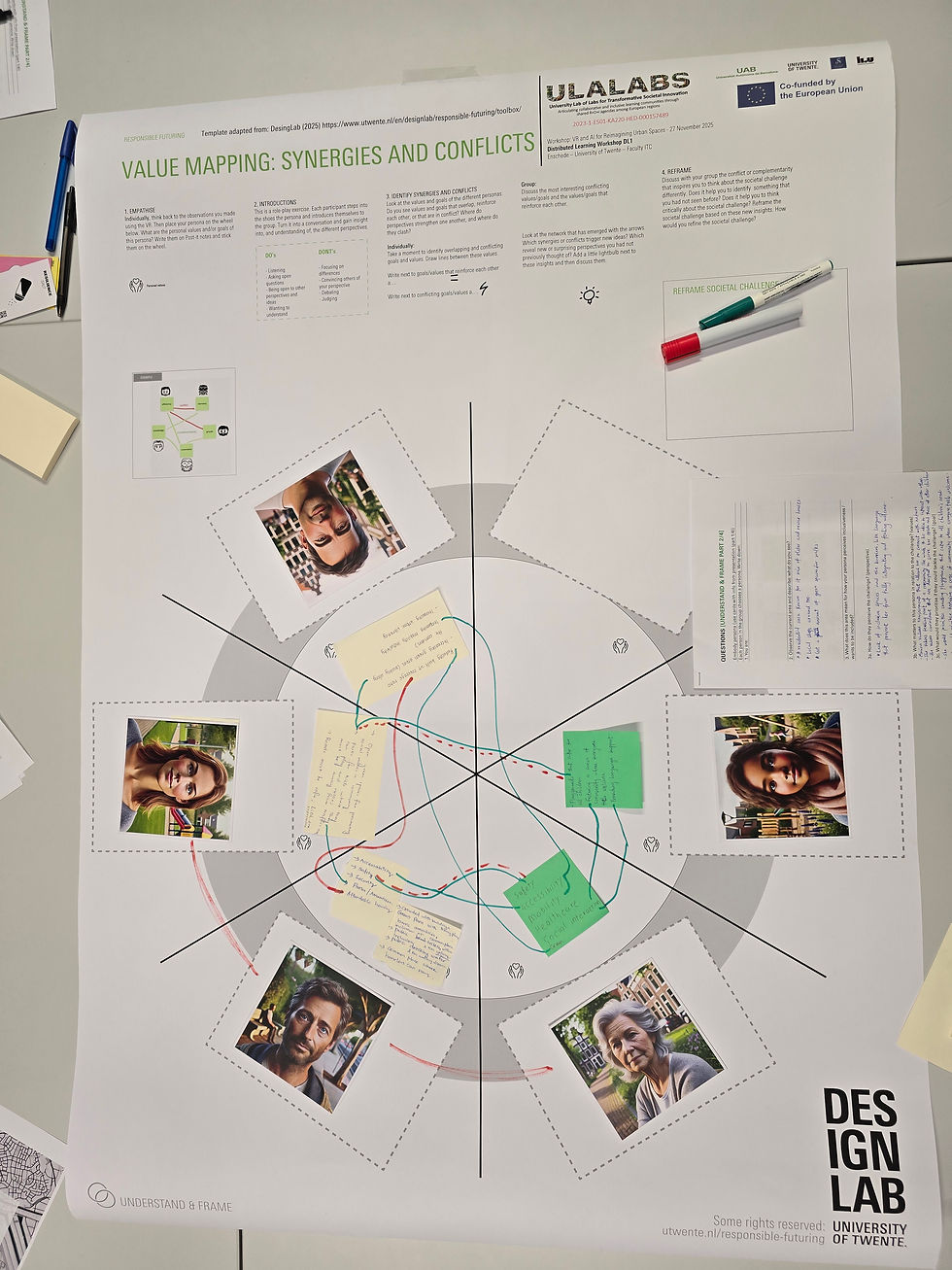
Value mapping: conflicts and synergies
Finally, groups brought their insights together in a group and plenary through value mapping (synergies & conflicts). With this mapping exercise, participants made visible the tensions and alignments across the values and goals of different personas, an essential step in designing for inclusivity.
Knowledge exchange at ’t Proathuus
At ’t Proathuus, Javier Martinez briefly introduced ULALABS. He recapped the Responsible Futuring workshop held during the first half of the morning, highlighting how values, personas, and immersive exploration were used to frame inclusive public space design in Twekkelerveld. Workshop participants also shared their experiences and initial takeaways from using these methods.
University of Twente researchers Julia Foellmer, Carmen Anthonj, and Paula Janeka then shared key findings from their research in Twekkelerveld. Julia Foellmer shared the WISER Horizon Europe Twekkelerveld case on “Disadvantaged groups’ perspectives on the built and natural environment.” The study shows that well-being is closely linked to everyday neighbourhood conditions: safe and accessible streets (especially for people with limited mobility), nearby facilities, and attractive walking/cycling routes, as well as well-maintained green spaces that support relaxation and physical activity. It also points to recurring concerns—such as pavement obstacles, cleanliness and waste, and perceptions of greenery—highlighting how practical barriers can reduce the benefits of the built and natural environment for disadvantaged groups.
Carmen Anthonj and Paula Janeka also shared insights from the VU–UT collaboration on co-designing climate-sensitive blue and green spaces in Twekkelerveld, developed in close collaboration with residents and the Municipality of Enschede. In that project, they tested an AI-supported co-design tool (UrbanistAI) that lets residents visually suggest changes—such as adding trees, benches, or water features—directly on images of their neighbourhood.
These insights provided a strong evidence base for reflecting on how design choices can unintentionally reproduce inequalities if lived experience and everyday constraints are not meaningfully taken into account.
Municipality of Enschede: area-based approach and vision for “Nieuw Twekkelerveld”
The final presentation, from Mark Jansen (Municipality of Enschede), connected the workshop to the city’s area-based approach for Twekkelerveld, known as Nieuw Twekkelerveld. The municipality frames this as a long-term effort to improve the neighbourhood’s liveability and future resilience, working together with housing corporations, residents and other partners.
The municipal vision emphasises a neighbourhood with challenges but with character and history, for young and old, where residents feel proud and supported by core values such as developing together, greater cohesion, and space for spontaneous meetings. The municipality highlighted how this vision is being translated into a programme of concrete projects and investments. They include, among others, strengthening a green-blue approach, including plans for a greener shopping area, investing in a new community centre as a central meeting place and support hub to strengthen social infrastructure and address one of the visions: “everybody belongs here”.
The intervention of this ULALABS stakeholder added a crucial layer to the workshop: it showed how methods such as personas, value mapping and immersive exploration can inform (and be informed by) planning and real governance processes.
Reflections and next steps
A key reflection from the day was not only what we design, but how we design, and for whom. Immersive tools such as VR can make discussions about places feel more “present” and tangible, personas can surface perspectives we might otherwise miss, and value mapping can help teams make trade-offs explicit and increase empathy.
The outcomes of this workshop and the students’ challenge-based learning work will be presented and discussed with colleagues from the municipality at the end of January, continuing the dialogue on how participatory methods and emerging technologies can support more inclusive and sustainable urban transformation.


Comentaris