
Insights from the ULALABS Webinar on Transferring Learning Across Institutional Contexts in Challenge-Based Approaches
On 15 June 2026, the ULALABS community gathered for the second webinar of the Erasmus+ ULALABS Cross-Case Learning pilot, building on the discussions initiated in May on challenge-based approaches at city level. The session was led and moderated by dr Igor Pessoa (Assistant Professor in Urban Governance, Public Administration, University of Twente), who guided the discussion and the roundtable exchange.
While the first session focused on how to design and organise challenge-based processes, this second webinar moved one step further—exploring a key question for urban transformation: how can learning generated in one context be transferred, sustained, and adapted across institutions and ecosystems?
Framed around the theme “Transferring learning across institutional contexts – insights from urban sustainability transformations,” the session brought together perspectives from research, practice, and education, highlighting both the potential and complexity of scaling and embedding learning.
From Projects to Institutional Learning
Opening the session, Prof. Dr. Barend van der Meulen (University of Twente) introduced a critical reflection on “projectification”—the tendency to organise innovation through time-bound projects. While projects often succeed in creating valuable knowledge and experimentation spaces, he highlighted a recurring challenge: learning often remains within the project and does not translate into lasting institutional change.
A key takeaway was the distinction between knowledge creation and learning: generating insights is not enough—mechanisms are needed to embed them into organisational practices, policies, and cultures. This points to the importance of moving beyond temporary initiatives towards institutional learning processes.
In addition, he introduced the concept of boundary work, emphasising how collaboration across organisations requires both bridging and redefining boundaries between different stakeholders—such as researchers, policymakers, and citizens. While living labs aim to create shared spaces for collaboration, they also inevitably generate new boundaries, for example between project participants and those outside the process. Managing these dynamics is essential for enabling meaningful collaboration and ensuring that learning can move beyond project settings and be taken up more widely within institutions.

Connecting Fragmented Efforts: Lessons from Stadswerkplaats
Maya van den Berg (DesignLab, University of Twente), Angela Rijnhart (Municipality of Enschede), and Janko Bartelink (University of Twente) shared insights from the Stadswerkplaats/City Lab initiative, a city-level collaboration initiative in Enschede that brings together municipalities, universities, and community actors to experiment with and learn from real-world challenges related to citizen participation and urban transformation.
Rather than functioning as a single project, it acts as a connecting space for multiple initiatives, aiming to strengthen collaboration and knowledge exchange within the local innovation ecosystem.

Their experience highlighted a common challenge:urban innovation ecosystems often consist of many valuable but fragmented initiatives, where knowledge remains siloed within individual projects. Rather than creating new structures, the initiative focuses on:
Connecting people, projects, and methods
Building communities of practice
Leveraging existing knowledge across institutions
A key insight was that impact does not necessarily come from more projects, but from better connections between them, supported by continuous exchange and shared learning across stakeholders.
Institutionalising Challenge-Based Learning
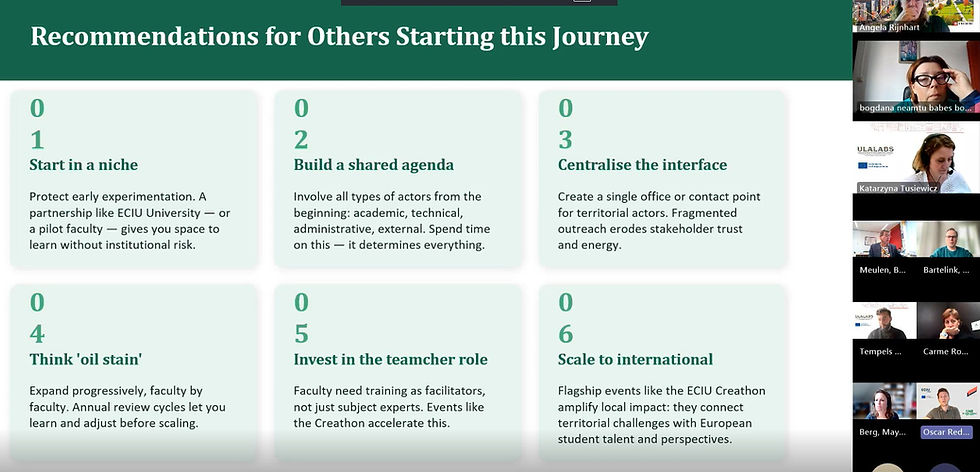
Oscar Redondo (Universitat Autònoma de Barcelona & ECIU University) provided a perspective on scaling challenge-based learning within a university setting, drawing on the experience of UAB as part of the ECIU University alliance.
Within this context, ECIU University has provided a protected space for experimentation and collaboration across institutions, enabling universities to pilot challenge-based approaches, share practices, and develop common frameworks at a European scale. This has been instrumental in supporting UAB’s transition towards more integrated and impact-driven learning models.
At UAB, the establishment of a dedicated Challenge Office has been crucial in moving from fragmented initiatives to a more structured and sustainable approach. This enabled:
Systematic collaboration with external stakeholders
Integration of challenges into curricula
Growth in student participation and institutional adoption
A concrete example shared during the session was the ECIU Creathon, an intensive, short-term format where international, multidisciplinary teams of students work on real societal challenges. This illustrated how challenge-based learning can operate across contexts, while highlighting the need to connect short-term learning activities to longer-term processes and impact.

At the same time, the experience revealed important challenges and barriers:
Stakeholders often expect outputs rather than co-creation processes
Administrative systems are not always aligned with flexible, challenge-based approaches
Scaling requires continuous coordination and facilitation
The key lesson: institutionalisation requires dedicated structures, but also broader cultural change, supported by collaboration across institutions—such as within the ECIU University alliance.
FSPAC Living Lab: Adapting Challenge-Based Approaches to Local Contexts
Prof. Dr. Bogdana Neamtu (Babeș-Bolyai University, Cluj-Napoca) presented the FSPAC Living Lab, a faculty-level initiative designed to strengthen the university’s engagement with the local community through challenge-based approaches.
The lab brings together multidisciplinary student teams, faculty mentors, and external stakeholders—including public institutions, NGOs, and companies—to co-create solutions to real societal challenges. Operating initially as an extracurricular initiative due to rigid curricula, the Living Lab has evolved through iterative experimentation and strong reliance on existing local networks.

Its experience highlights several important elements:
The value of long-term partnerships with returning stakeholders, which improve collaboration over time
The importance of mentorship and facilitation in supporting student learning processes
The need for continuous adaptation, both within project cycles and across iterations
The experience illustrated that successful transfer is not about replication, but about adaptation—shaped by local governance structures, institutional constraints, and available resources.

Roundtable Discussion: Sustaining Learning Beyond Projects
The discussion brought together a central theme emerging across all contributions:challenge-based approaches create powerful learning environments, but their long-term impact depends on how learning is carried forward beyond individual projects.
Participants reflected on several shared challenges:
Translating project-based insights into institutional practice
Aligning different organisational cultures and expectations
Ensuring continuity beyond project timelines
Recognising learning as an ongoing, collective process
At the same time, the discussion emphasised that these challenges also represent opportunities: by strengthening reflection, feedback loops, and collaboration across stakeholders, learning can be progressively embedded into organisational routines and decision-making processes. A recurring insight was the importance of reflection and shared learning spaces—not only for students, but also for stakeholders and institutions involved. Making learning more explicit, rather than implicit, was seen as key to strengthening long-term impact.
Looking Ahead
A key takeaway across both pilot learning sessions is that challenge-based approaches are not isolated interventions, but long-term, relational processes. Their success depends not only on experimentation, but also on the ability to connect, adapt, and sustain learning across institutional boundaries.

These reflections strongly resonate with the ULALABS Learning Communities Roadmap, which explores how collaborative learning processes can be structured and supported across different contexts. We invite you to explore the roadmap here.
Ihe coming period, we will also share a dedicated Learning Toolkit for this cross-case pilot, bringing together insights from both webinars, along with additional resources, methods, and practical guidance.
Stay tuned as we continue to build and share knowledge across the ULALABS community!

Comentaris