
Insights from the ULALABS Webinar on Knowledge Generation and Sharing in Urban Challenge-Based Processes
On 27 May 2026, the ULALABS community gathered for a webinar organised by the University of Twente as part of the Erasmus+ ULALABS Cross-CASE Learning pilot on “How to set up challenge-based processes at city level?”.

The session explored how challenge-based approaches can support collaboration between universities, cities, and communities, and how knowledge can be co-created and translated into meaningful impact in local urban transformation processes.
The webinar forms part of a broader effort within the cross-case pilot to establish a baseline of diverse learning experiences related to knowledge sharing in local transformation processes. As highlighted during the opening by Dr. Veronica Junjan (Department of Public Administration at the University of Twente), the aim is not only to exchange practices, but also to better understand the barriers, enablers, and values that shape collaboration in challenge-based approaches.
From Theory to Practice: Three Perspectives
1. Applying Challenge-Based Processes in Local Governance
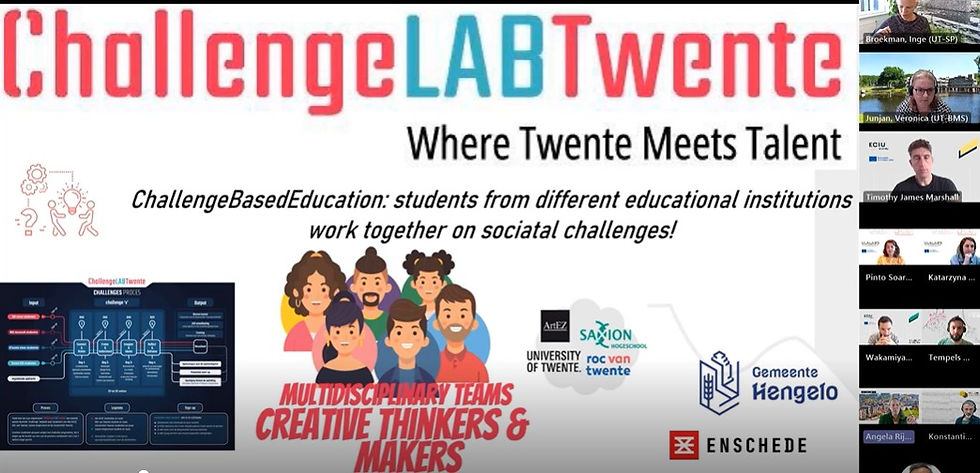
Angela Rijnhart (Municipality of Enschede) presented how challenge-based approaches are implemented through Challenge Lab Twente*, where municipalities, universities, and other partners collaborate around real societal challenges.
She emphasised that for challenge-based processes to be effective, they need:
Structural support (e.g. learning communities, online platforms, toolboxes)
Recognition of multiple knowledge types (scientific, policy, citizen, experiential)
Alignment with broader urban transformation strategies and focus on long-term impact
A key insight was that challenge-based approaches can move beyond isolated projects by using tools such as knowledge agendas, enabling stakeholders to define and align around shared research and action questions and ensure continuity over time.
At the same time, among common barriers and challenges, Angela included limited time and funding, differing institutional cultures, and a lack of shared language.
* Read more in our publication Emerging Lab of Labs, where Challenge Lab Twente is featured as one of the case studies.
2. Teaching Perspective: Learning Through Real-World Challenges
Dr. Mafalda Madureira (University of Twente) provided insights into how challenge-based learning (CBL) is applied in education. By sharing concrete examples, she showed how students engage with real challenges from local stakeholders—moving through stages of engage, investigate, and act—to develop solutions grounded in real-world contexts.
This approach enables:
Stronger connections between universities and local communities; direct interaction with stakeholders, including municipalities and communities
Student-driven learning processes with a structured yet flexible methodology (engage–investigate–act)
Increased awareness of locally-grounded challenges, increasing student motivation and relevance
At the same time, among the key challenges and difficulties, Mafalda mentioned:
Short timeframes (e.g. 10-week courses) limiting depth and implementation
Difficulty in moving from analysis to actual implementation
The need to align academic and stakeholder expectations
Occasional language and communication barriers in stakeholder interaction
This perspective highlighted an important tension: while challenge-based learning is highly effective as a learning approach, its impact depends on how well it connects to longer-term processes beyond the course.

Scaling Challenge-Based Approaches Across Europe
Ryan Wakamiya (ECIU University) and Tim Marshall (University of Stavanger) explored how challenge-based learning is implemented at the scale of a European university alliance- ECIU University.
Their contribution highlighted both opportunities and complexity:
Multinational and multidisciplinary collaboration enriches learning
Structured collaboration platforms (e.g. Engage platform, communities of practice)
A strong pedagogical framework and short, flexible formats (e.g. blended programmes) increase accessibility
Institutional support through alliances and shared governance structures
However, maintaining continuity, ownership, and long-term impact remains challenging.
Resource constraints, particularly for mobility and in-person collaboration
Tension between accessibility (short formats) and depth of engagement (long formats)
A key insight was the importance of connecting short-term learning activities to longer-term processes and governance structures, ensuring that knowledge generated through challenges is not lost but built upon over time, and translated into impact.
The speakers also highlighted ongoing efforts to consolidate knowledge within the alliance, including a recent book co-authored by Tim Marshall that brings together case studies and insights on challenge-based learning across ECIU universities.

Roundtable discussion
The discussion, facilitated by dr. Veronica Junjan, that followed brought together the different perspectives into a shared reflection on what it actually takes to make challenge-based processes work in practice. A recurring theme was that these processes are not simply projects, but evolving collaborations that rely on long-term relationships, trust, and continuous exchange. Participants emphasised that while challenge-based approaches create valuable spaces for experimentation and learning, their real impact depends on how well they are embedded in broader, ongoing transformation processes—whether within municipalities, universities, or wider ecosystems.
Speakers also reflected on the central role of stakeholders and intermediaries in sustaining these processes. Rather than a single “owner,” challenge-based approaches depend on a network of actors—municipalities, educators, students, and communities—each contributing different forms of knowledge and value. At the same time, this diversity introduces complexity: aligning expectations, timelines, and institutional requirements remains a key challenge. The conversation highlighted the importance of individuals and structures that can act as connectors—translating between different “languages” (academic, policy, citizen) and ensuring that knowledge generated in one setting can be built upon in another.
Finally, the discussion returned to a core insight of the ULALABS approach: transferring learning across contexts is not straightforward. Practices cannot simply be replicated; they must be adapted through what participants described as a process of “creative translation.” This requires openness to different contexts, as well as time and continuity—elements that are often constrained in project-based settings.
Building on these reflections, the conversation will continue in the next webinar on Monday, 15 June (12:00–13:30 CET), focusing on Transferring learning across institutional contexts with insights from urban sustainability transformations. Save the Date and looking forward to continuing the discussions!


Comentaris